
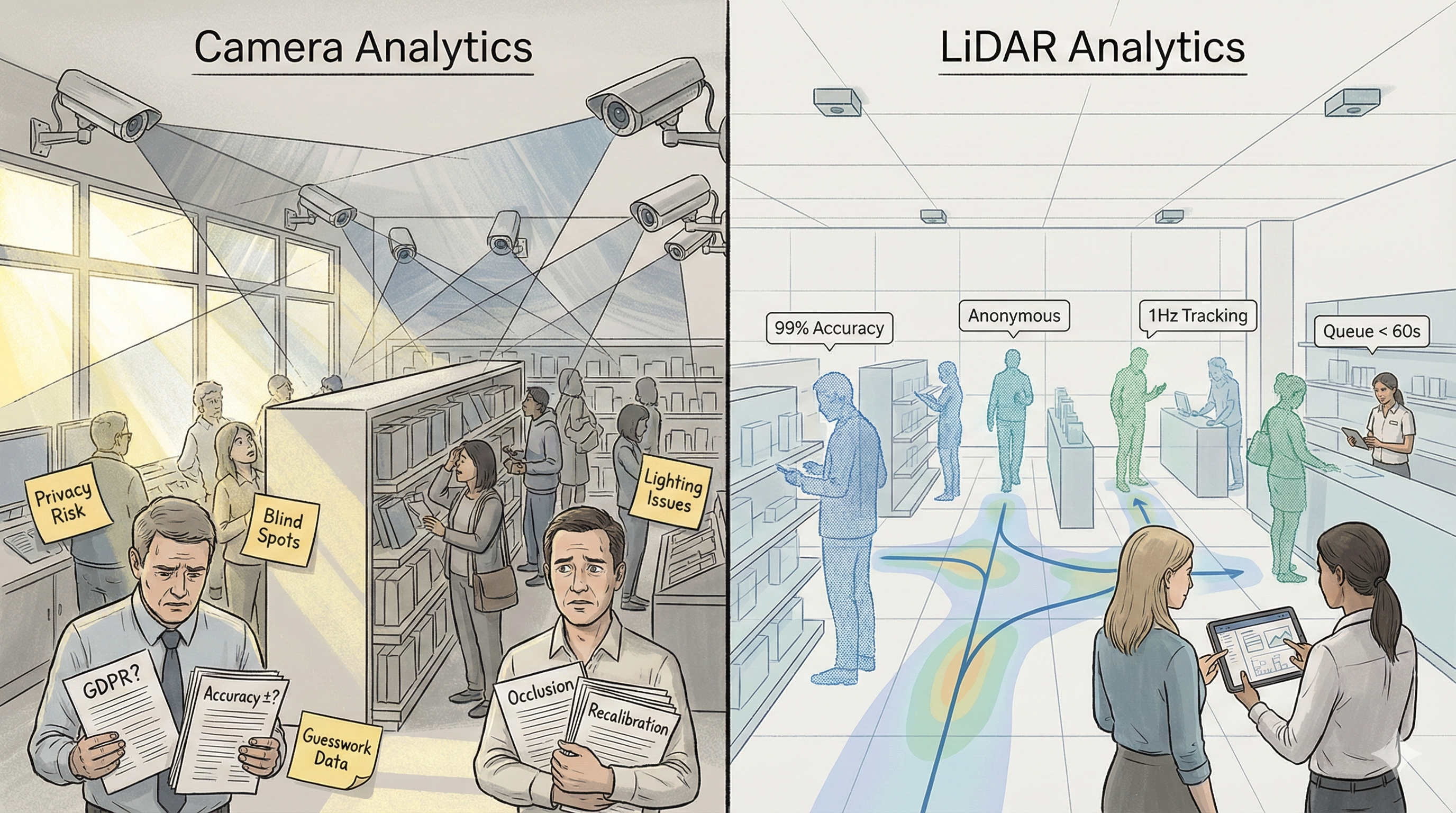
For retailers, understanding in-store customer behavior is the holy grail. For years, video analytics — using cameras and computer vision — has been the go-to solution. But a new technology, LiDAR, is rapidly emerging as a superior alternative, offering unparalleled accuracy and privacy.
So, which is right for your business? This article provides a direct, technical comparison of LiDAR vs. camera analytics across the metrics that matter most.
What is LiDAR and How is it Different?
Camera Analytics work by capturing and interpreting 2D images. Computer vision algorithms analyze these images to identify people, track their paths, and estimate behaviors like dwell time. The system is fundamentally dependent on visual information — lighting, contrast, and clear sightlines.
LiDAR (Light Detection and Ranging) works by emitting pulses of invisible laser light (typically 905nm wavelength) and measuring how long they take to return. This creates a real-time 3D point cloud of the environment — a hyper-accurate, depth-aware map of the space and everything in it.
Platforms like Hyperspace then process this point cloud to track the movement of every person and object with millimeter-level precision. The system samples at 1Hz (one position reading per second per person), creating a complete trajectory dataset.
Head-to-Head Comparison
| Feature | LiDAR Analytics (Hyperspace) | Camera Analytics | Winner |
|---|---|---|---|
| Tracking Accuracy | 99%+ | 75–90% (varies greatly) | LiDAR |
| Privacy Compliance | 100% Anonymous by Design | High Risk (captures PII) | LiDAR |
| Lighting Performance | Unaffected | Degrades in low light, glare, shadows | LiDAR |
| 3D vs. 2D Tracking | True 3D Spatial Tracking | 2D Image Interpretation | LiDAR |
| Occlusion Handling | Excellent (sees around objects) | Poor (loses track when blocked) | LiDAR |
| Crowd Density | Unlimited (100+ simultaneous) | Degrades above 20 people | LiDAR |
| Data Granularity | 1Hz position sampling | Frame-based (15–30 FPS, lossy) | LiDAR |
| Installation | Ceiling-mount, minimal cabling | Extensive cabling and power | LiDAR |
| Maintenance | Minimal (no lens cleaning) | Regular cleaning, recalibration | LiDAR |
| Hardware Cost | Moderate (falling rapidly) | Low to Moderate | Draw |
| Compliance Overhead | Zero (no PII captured) | High (GDPR, CCPA, signage, consent) | LiDAR |
| Public Perception | Neutral / Positive | Increasingly Negative | LiDAR |
1. Accuracy & Reliability: The Data You Can Trust
Camera accuracy is notoriously inconsistent. Shadows, bright sunlight, reflections, and clothing color all affect results. Crowd counting is a rough estimate, and tracking through a busy store is error-prone.
LiDAR is a measurement tool, not an interpretation tool. It measures distance and shape with laser precision, resulting in over 99% tracking accuracy in all conditions.
2. Privacy by Design: The Competitive Differentiator
This is LiDAR's single greatest advantage. Camera systems capture Personally Identifiable Information (PII) by default — faces, clothing, gait. This creates a massive compliance burden and risk to customer trust.
Many camera-based analytics systems are simply illegal in jurisdictions like the EU without explicit, opt-in consent from every shopper — a non-starter for any retailer.
LiDAR is anonymous by design. It generates a point cloud of abstract shapes. It is physically impossible to identify an individual from LiDAR data.
What Hyperspace Captures:
- Position data: (x, y, z) coordinates in 3D space
- Velocity: Movement speed and direction
- Zone interactions: Which areas a person entered and exited
- Dwell events: How long they stayed in each zone
What Hyperspace NEVER Captures:
- ❌ Faces or facial features
- ❌ Clothing or appearance
- ❌ Gender, age, or demographics
- ❌ Any personally identifiable information
In an age of increasing consumer skepticism about data collection, offering a truly anonymous analytics solution is a powerful brand differentiator. Retailers using Hyperspace can confidently market their stores as "privacy-first" environments.
3. Superior Performance in Real-World Conditions
Retail environments are chaotic — lighting changes, crowds surge, displays get moved. Camera systems struggle with this variability:
- Glare from a window can blind a camera for hours
- Shadows can be misinterpreted as objects or people
- Crowds make it impossible to track individuals accurately
- Reflective surfaces (glass, polished floors) confuse computer vision
- Varying lighting (daylight vs. evening) requires constant recalibration
LiDAR is immune to these issues. Because it generates its own light, it is completely unaffected by ambient lighting. Its 3D capability handles dense crowds with ease.
4. Scalability & Deployment Efficiency
- Extensive cabling (power + data per camera)
- 10–20+ cameras for 2,000m²
- Overlapping coverage = double-counting
- Regular cleaning & recalibration
- Ceiling-mount, minimal cabling
- 4–6 sensors for 2,000m²
- Multi-sensor fusion, no double-counting
- Self-calibrating, minimal maintenance
The Hyperspace Deployment Process:
- Planning: Web-based LiDAR Coverage Planner simulates optimal placement
- Installation: Mount sensors on ceiling (like WiFi access points)
- Commissioning: Edge Commissioning Portal — pair sensors and deploy remotely
- Validation: Real-time LiDAR Network Panel shows connection status
- Go-Live: Analytics dashboard starts displaying insights immediately
5. Advanced Analytics Capabilities
Because LiDAR provides true 3D position data at 1Hz, it enables analytics that are impossible with cameras:
| Feature | Hyperspace (LiDAR) | Camera Capability |
|---|---|---|
| Queue Management | Millisecond precision tracking | ❌ Unreliable in crowds |
| Velocity Analysis | Browsing vs. passing differentiation | ❌ Frame-rate limited |
| Heatmap Accuracy | True occupancy with exact dwell locations | ⚠️ Approximate |
| Path Reconstruction | Complete journey, entrance to exit | ❌ Loses tracks frequently |
| DOOH Attribution (PEBLE™) | Attention measurement + post-exposure behavior | ❌ Cannot measure accurately |
| Shelf-Level Analytics | Per-product engagement tracking | ❌ Requires very high resolution |
| AI Narrator | Natural language insights and suggestions | ⚠️ Limited by data quality |
When Are Cameras Still Useful?
Cameras are not obsolete, but their role is changing. They remain essential for two functions:
- Security & Loss Prevention: When you need to identify a specific individual for security reasons. However, this should be a separate system from your analytics infrastructure.
- Demographics (with caution): Computer vision can attempt to estimate age and gender, though accuracy is often below 70% and carries the same privacy risks.
For operational analytics — understanding flow, dwell time, queue length, and layout effectiveness — LiDAR is the clear winner.
The Total Cost of Ownership
While a single camera costs less than a single LiDAR sensor, the total cost of ownership for a comprehensive system often favors LiDAR:
| Cost Factor | Camera System | LiDAR System (Hyperspace) |
|---|---|---|
| Hardware | $200–500 × 15–20 units = $3,000–10,000 | $1,500–3,000 × 5–6 units = $7,500–18,000 |
| Installation | 2–3 days, extensive cabling = $3,000–5,000 | 1 day, minimal cabling = $1,500–2,500 |
| Software License | $500–2,000/month | Included (or LiDAR-as-a-Service) |
| Compliance Costs | Legal review, signage, consent = $5,000–20,000 | $0 (no PII captured) |
| Maintenance | Lens cleaning, recalibration = $200–500/month | Minimal (~$50/month) |
| Data Quality | 75–90% accuracy = hidden cost in bad decisions | 99%+ accuracy = confidence in decisions |
LiDAR-as-a-Service: Hyperspace offers a zero-CAPEX deployment model — a monthly fee per sensor, eliminating upfront hardware costs entirely.
Conclusion: The Choice is Clear
For retailers seeking accurate, reliable, and privacy-respecting data on in-store behavior, LiDAR is the definitive modern solution. While cameras will always have a role in security, they are an outdated and risky choice for customer analytics.
About Hyperspace: Hyperspace is the leading Physical AI platform for retail, using LiDAR sensors to provide privacy-first spatial analytics. Our mission is to help retailers understand and optimize their physical spaces without compromising customer privacy.